Showing posts with label sculptures. Show all posts

Monday, November 7, 2011

Commodus and Caracalla


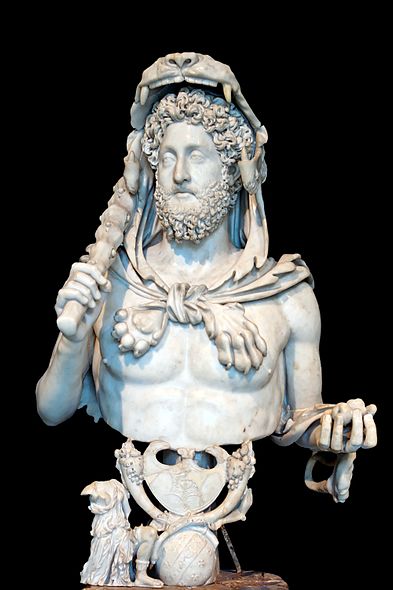
The pieces featured Commodus as Hercules and the head of Caracalla are similar however provides some distinct differences that help to visualize how the rules portray themselves. The bust of Commodus as Hercules is made from marble in typical roman fashion. In the message, Commodus seems to not rely on himself to appear great, but has to relate himself to being a descendent of the gods in the form of Hercules. He is depicted very ornately featuring almost perfect features and muscles, armed with a club, apples, and a lion’s fur, with distance hair and beard. It seems like he is trying to get the viewers of this piece to relate his image with that of Hercules, however, now days we do not have a good idea of what Hercules looks like, so to us, it just looks like Commodus is going to great lengths to add to his appearance. The bust uses light to its advantage with the use of the lions head as a hood; it focuses the eyes on Commodus’s face. Overall the image tried to depict Commodus as a worthy ruler that can be related to the gods, signifying that Commodus has divine backing, because he has relation to Hercules.
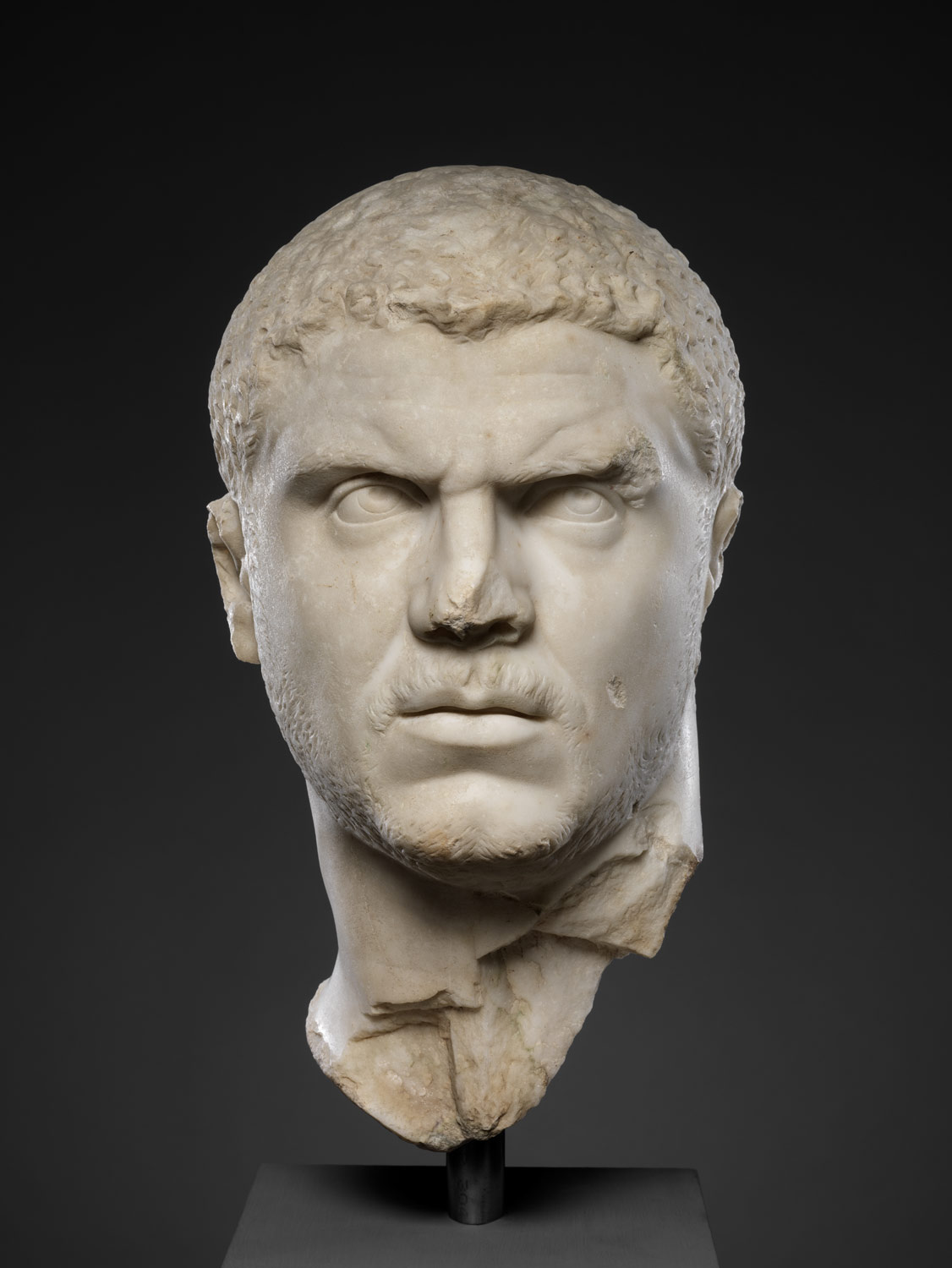

                The head of Caracalla, a bust as well, serves a use of propaganda but not in the form of presenting himself to be godly or appear to be someone he is not.  Just like the bust of Commodus, this is made out of marble and is a piece of propaganda. This however, is where the similarities end. The head of Caracalla does not show humans in their perfect form like the bust of Commodus as Hercules does. Instead, Caracalla has lines in his forehead, and a very stern brow. He presents staring eyes, with an almost frown upon his face. Along with this, his beard and hair are very short and barely visible unlike Commodus who has very curly hair and beard. This piece portrays Caracalla as a very serious ruler, just looking at his face a viewer can tell that he is not easy going and has a lot of concern in his face. This is unlike Commodus, who seems to have a very perfect, neutral expression. Someone looking at this piece from this time period would be able to relate the face with the struggles the empire is facing at the time and know that Caracalla, the stern looking ruler takes things seriously, unlike Commodus who is just playing dress up. Even looking back today, not knowing the time period or Caracalla by appearance, we can discern that he is indeed a serious man. Looking at his face, it might even give the viewer a sense of fear if against this man, or a sense of safety knowing that he is in control. His serious expression is even added upon with the use of lighting with the darkness on the right side of his face and the darkness above these eyes. Looking at these pieces, one gets the sense of the periods they lived in relation to the Roman Empire. Commodus, coming out of the height of the empire, is carefree, and able to portray himself as whatever he wishes in perfect form. While Caracalla has a more simple serious representation of himself, with no time to or need to represent him as anything different.

Monday, October 17, 2011

Post 4: Unknown Aegean Art


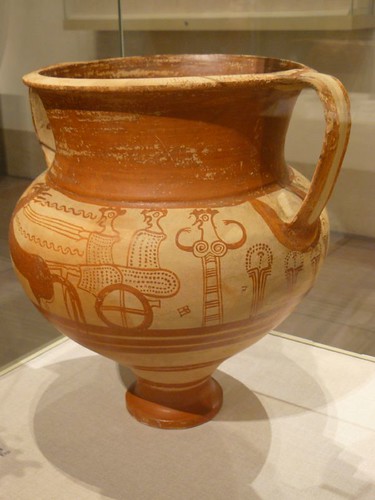
The unknown vase looks pretty tough to decipher which culture it came from but there are some characteristics of it which help move me in a particular direction. At first glance, it appears to have been made on a potter’s wheel, but all three cultures did that as well. The first culture I would exclude this from being is the Cycladic people. Based on the Kamares Ware jug on page 86, the designs are pretty different; the vase is depicting specific things with registers while the Kamares jug looks to be pretty abstract and simplified like Cycladic artwork. The Minoan culture could have made this based on the idea that it does depict nature in a way. I shy away from this though, taking a look at the Harvester Rhyton on page 89, it becomes clear that the Minoans use realistic depictions of people and show depth. This vase appears to be more in the form of cartoonish characters and everything is single file. This leaves me to believe that this vase is the work of the Mycenaean people. Bringing up the Warrior Krater on page 99, I can see some distinct similarities between the two. First, both use distinct registers at the top and bottom of the vase, although this seems to be pretty common amongst Aegean art. Although the vase does not depict a wartime scene like the Mycenaean tended to be, it seems to show more of a farming type scene. Being that the Mycenaean were based on mainland Greece, it does not seem odd that they could have been farmers too. Another point in relation to the Warrior Krater is the depiction of images with no depth, and in profile similar to how the soldiers have no depth. The images in the farm vase also seem to have a cartoonish outline to them, similar to the style of the soldiers in the Warrior Krater. Although it would be hard to pick, I would say the Mycenaean would be most likely to have created this vase.


The second image of the fisherman is also tough to place. Firstly all three Aegean cultures could have a relation with water in some way so geographically I so no help. Going down the list, I would first eliminate the Cycladic again based on the fact that this image looks to be more complex than most works such as the Figure of a Woman on page 82. Next I would exclude the Mycenaean due to the depiction of the human form. Using the Warrior Krater on page 99 as an example, humans are depicted non realistic and outlined while this image depicts a human more naturalistically. Based on that fact I would move onto the Minoans, who like the other two had a relation with water.  I really would like to think that this is a Minoan piece based on a few things. It is every humanistic and Minoan work such as the Harvester Rhyton appears to be realistic. It also incorporates part of the natural work, with the fish and that is something the Minoans are known for. Another thing similar to the Minoans is the incorporation of fish which is a sea creater. The Minoans seem to incorporate a lot to do with the ocean. Using the Flotilla Fresco on page 92, there seems to be pretty big similarities in the depiction of humans and sea creates in this image.