Showing posts with label Ancient Greece. Show all posts

Monday, October 31, 2011

The Pantheons Missing Marbles.


The location of the Parthenon Marbles in London does not surprise me. From what we have studies, with how old certain pieces of art are, the land that they exist on change hands quite a bit. Taking a look at the Ishtar Gates for example, this was originally in Babylon, ended up in Germany.  The final placement of art seems to relate to the history of its location. A museum such as the Louvre would not be as grand as it is if art did not get taken from their original locations.  This was seen with near eastern art as well, such as the Stele of NaramSin which was stolen and defaced in time.  In this case, the Turks, did not seem to value the history behind the Pantheon, using it for military purposes, and easily gave the marbles to Thomas Bruce.
                I do not like the idea of taking a piece of art out of its original context. These pieces were taken to study in an artificial environment. Yes this did allow many students to view and draw the marble sculptures, but besides their physical characteristics, what do the students get out of it?  They do get to admire different pieces up close which would not normally be at eye level. There is always a context to a piece of work and this is missing when they are taken out of the original location. The Elgin marbles were used to tell a story, many pierces to a great structure. I also do not like the fact that the reason for the moving of the marbles is because Lord Elgin wanted to decorate his house. We are talking about priceless statues which were a part of a larger temple. They are not stand alone pierces that should be used for decoration. Is the cost of being able to look at the marbles up close worth losing the background and purpose of the pieces? I do not think so, the historical context and purpose of the statues needs to be a part of the story.
                Although I do not see it ever happening, I do believe that the Pantheon marbles should return to Athens. The problem is ownership, the Turks who occupied the land did indeed give them to the British and the Greeks will have a hard time getting around this. In a perfect world, I would like them to be returned to the location of the Pantheon in Athens to be a part of a larger historical site. Although I do not think it is possible for them to return to their original location apart of the Pantheon, at least being at the sight will allow them to present some historical context, and relate them to the actual structure they were a part of. I think it would be really beneficial to apart of this exhibit, create images of how they would have looked in their original format. This way, they would be in the correct location, and visitors would be able to get a better sense of how Greek art really was, and witness the story the art tells rather than the individual separated figures. 

Monday, October 17, 2011

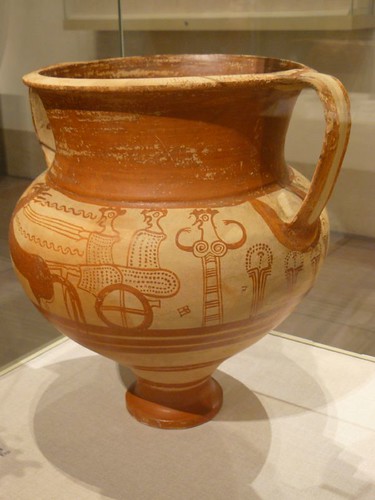
Post 4: Unknown Aegean Art


The unknown vase looks pretty tough to decipher which culture it came from but there are some characteristics of it which help move me in a particular direction. At first glance, it appears to have been made on a potter’s wheel, but all three cultures did that as well. The first culture I would exclude this from being is the Cycladic people. Based on the Kamares Ware jug on page 86, the designs are pretty different; the vase is depicting specific things with registers while the Kamares jug looks to be pretty abstract and simplified like Cycladic artwork. The Minoan culture could have made this based on the idea that it does depict nature in a way. I shy away from this though, taking a look at the Harvester Rhyton on page 89, it becomes clear that the Minoans use realistic depictions of people and show depth. This vase appears to be more in the form of cartoonish characters and everything is single file. This leaves me to believe that this vase is the work of the Mycenaean people. Bringing up the Warrior Krater on page 99, I can see some distinct similarities between the two. First, both use distinct registers at the top and bottom of the vase, although this seems to be pretty common amongst Aegean art. Although the vase does not depict a wartime scene like the Mycenaean tended to be, it seems to show more of a farming type scene. Being that the Mycenaean were based on mainland Greece, it does not seem odd that they could have been farmers too. Another point in relation to the Warrior Krater is the depiction of images with no depth, and in profile similar to how the soldiers have no depth. The images in the farm vase also seem to have a cartoonish outline to them, similar to the style of the soldiers in the Warrior Krater. Although it would be hard to pick, I would say the Mycenaean would be most likely to have created this vase.


The second image of the fisherman is also tough to place. Firstly all three Aegean cultures could have a relation with water in some way so geographically I so no help. Going down the list, I would first eliminate the Cycladic again based on the fact that this image looks to be more complex than most works such as the Figure of a Woman on page 82. Next I would exclude the Mycenaean due to the depiction of the human form. Using the Warrior Krater on page 99 as an example, humans are depicted non realistic and outlined while this image depicts a human more naturalistically. Based on that fact I would move onto the Minoans, who like the other two had a relation with water.  I really would like to think that this is a Minoan piece based on a few things. It is every humanistic and Minoan work such as the Harvester Rhyton appears to be realistic. It also incorporates part of the natural work, with the fish and that is something the Minoans are known for. Another thing similar to the Minoans is the incorporation of fish which is a sea creater. The Minoans seem to incorporate a lot to do with the ocean. Using the Flotilla Fresco on page 92, there seems to be pretty big similarities in the depiction of humans and sea creates in this image.